Projects

Case studies in user research and data science

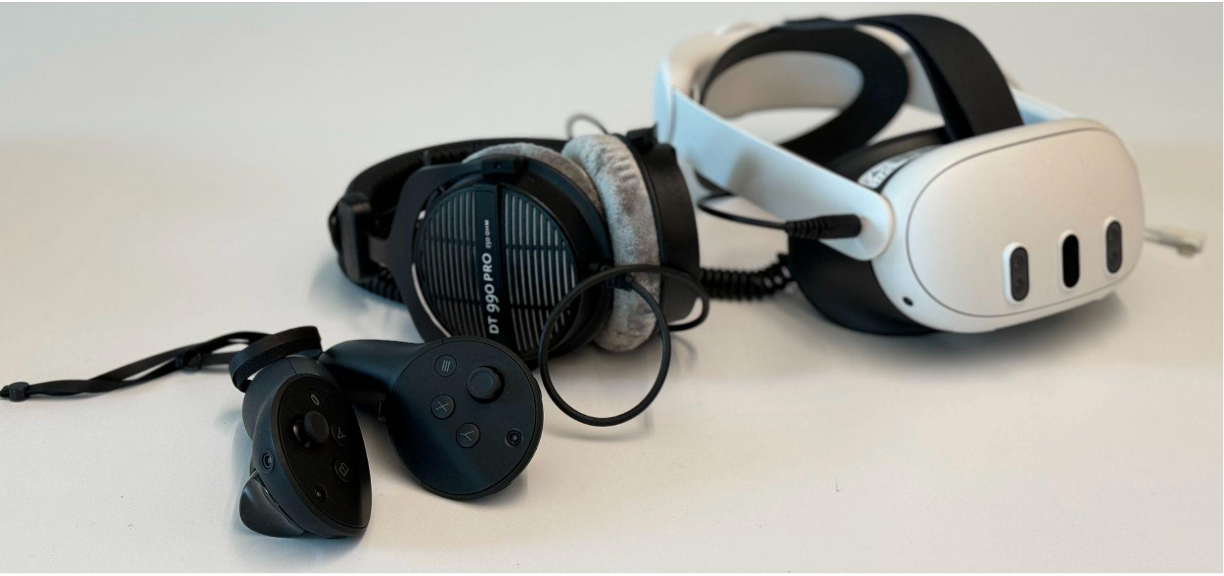
Quest 3 VR headset setup
Published Research VR Spatial Audio Meta Reality Labs

Individual Differences in Learning to Localize Spatial Audio in VR

Problem

Personalizing HRTFs (the acoustic filter that shapes how each individual perceives spatial audio, based on their unique ear/head/torso anatomy) is expensive and hard to scale. A key question for VR audio product development is whether users actually need personalized HRTFs, or whether a well-designed generic HRTF combined with brief training is sufficient.

Approach

Our experiments on the Quest 3 headset compared naive listeners vs. those who completed a short training block with visual feedback, tested on both a generic and their own personalized HRTF. Localization accuracy was measured across azimuth, elevation, arc error, and front/back and top/bottom confusions.

Findings

Training had a large effect: among naive listeners, 58% were unable to localize spatial audio from all directions; after training, only 12% remained non-sensitive. Training reduced average arc error by ~17°. HRTF personalization had a statistically significant but small effect (~5° reduction in arc error), mainly improving elevation at extreme angles. These findings suggest that a generic HRTF combined with brief training may suffice for most VR applications — with implications for how onboarding should be designed and whether costly personalization pipelines are needed.
Download Preprint
Auditory spatial mapping figure from paper
Published Research Spatial Audio VR Meta Reality Labs

Auditory Spatial Mapping: How Prior Context Warps Sound Perception

Problem

Audio personalization for VR headsets assumes a stable mapping between acoustic cues and perceived sound locations. But if the auditory spatial map shifts dynamically based on recent listening context, personalization may not be as important in real-world use where the acoustic environment constantly changes.

Approach

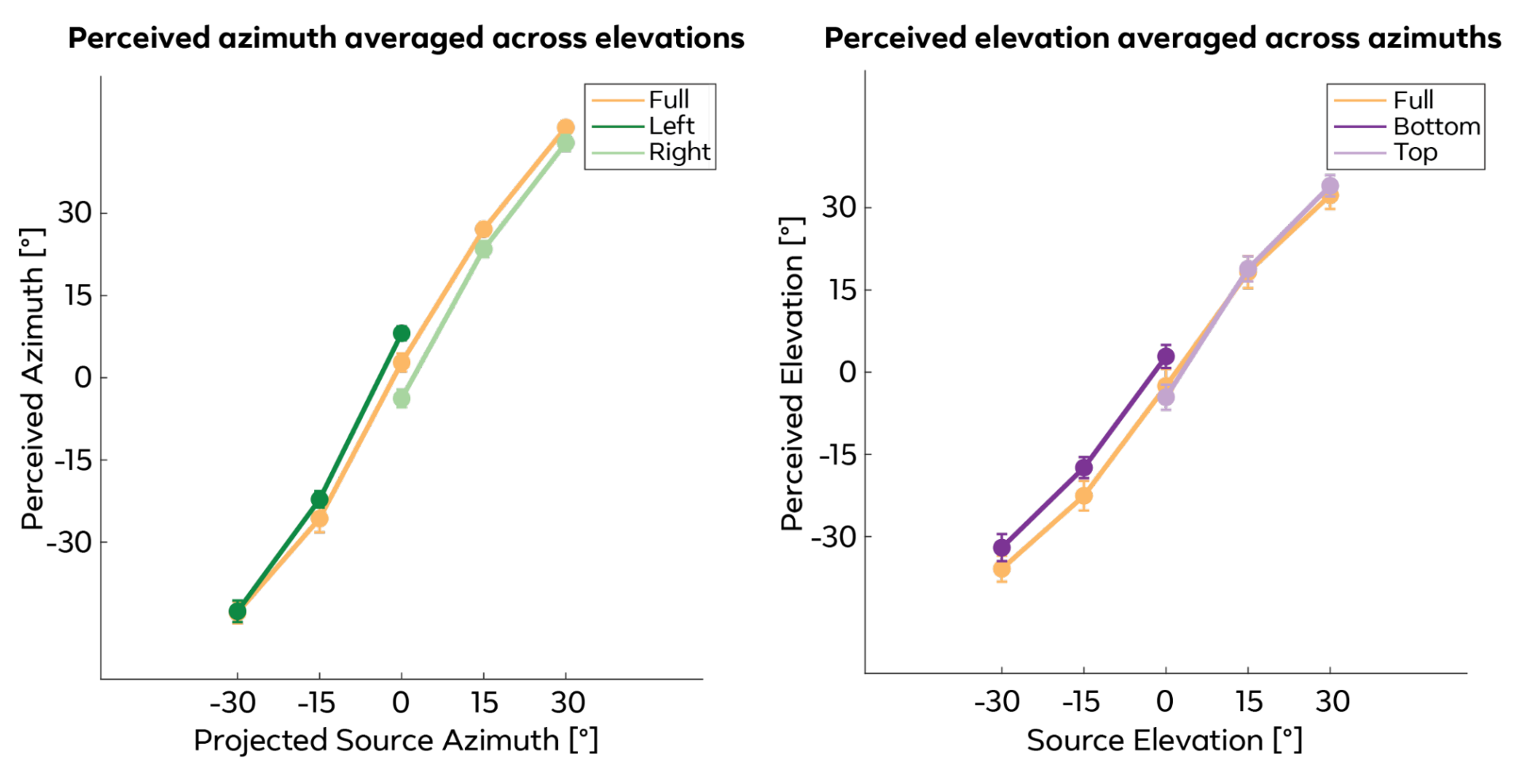
We presented participants with sounds in blocked spatial contexts on the Quest 3 headset — either across the full range or restricted to the left, right, bottom, or top hemispace — and measured perceived azimuth and elevation without feedback. By comparing localization across contexts, we isolated how the statistics of recent sounds bias spatial perception.

Findings

Contextual blocking systematically shifted sound perception: sounds at 0° azimuth were perceived ~3–6° toward the contralateral side. Sounds in the bottom context showed an upward bias in perceived elevation (~4.5°); the top context had no significant effect. These results show that the auditory spatial map is dynamic — continuously recalibrating to the statistics of the current sound environment — with implications for how adaptive audio systems in VR should be evaluated and designed.

Download Preprint
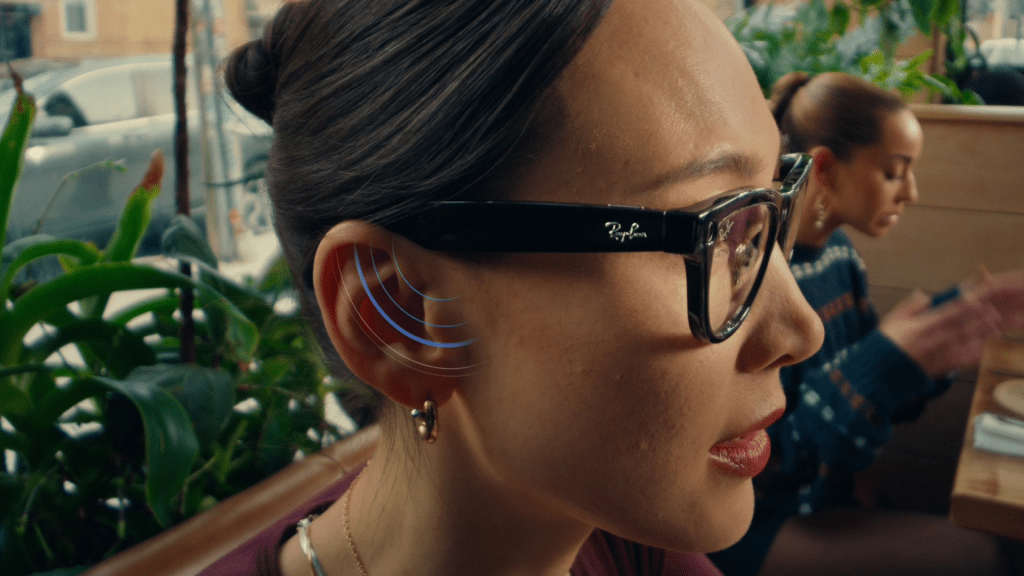
Ray-Ban Meta glasses — Conversation Focus feature
Photo: Meta
Shipped Feature UX Research Psychophysics Wearables Meta Reality Labs

Conversation Focus — Ray-Ban Meta Glasses

Problem

We often find that it's hard to hear your conversation partner in noisy environments. To develop Conversation Focus — a feature that amplifies the voice of the person you're talking to — we needed rigorous measurement of how much speech amplification on the glasses is needed and how to make conversation feel natural.

Approach

I co-led a series of onsite user studies measuring the thresholds at which participants could reliably understand speech across varying noise levels. Studies were conducted in controlled acoustic environments with real participants.

Impact

These studies directly informed the algorithm design and tuning of Conversation Focus. The feature has been shipped to Ray-Ban Meta users.

Holiday celebrations
Data Science Forecasting Infrastructure Meta Family of Apps

Holiday Traffic Forecasting for Media Infrastructure

Problem

Holidays like Thanksgiving, Christmas, and New Year increase media traffic on Messenger as users share significantly more photos, videos, and audio with family and friends. Without accurate forecasting, engineering teams cannot proactively scale infrastructure, leaving systems exposed to reliability risk at peak load.

Approach

I performed forecasting analysis using historical traffic data to project holiday-period media send volumes for different countries and media types.

Impact

Results were shared with infrastructure and engineering teams ahead of the holiday period, enabling proactive capacity decisions.

Messaging apps benchmarking
Data Science UX Research Benchmarking Meta Family of Apps

Media Messaging Benchmarking

Problem

To prioritize the messaging media roadmap, the team needed a rigorous, multi-dimensional view of how Meta's messaging apps compared to each other and to key external competitors, across media types, devices, network conditions, etc.

Approach

I conducted a benchmarking analysis of messaging apps looking at: (1) Engagement — topline media sends, active users, etc. using production data; (2) Performance, reliability, efficiency, and quality — metrics per media type; (3) User feedback — thematic analysis of App Store, Google Play, and Reddit reviews to surface common media-related pain points; and (4) Lab benchmarking — controlled studies comparing the performance across different apps.

Impact

The benchmarking identified concrete gaps across messaging apps, directly informing the messaging media roadmap. Findings were presented to leadership and cross-functional partners, translating user insights and production signals into prioritized engineering investments.

Media upload quality vs. size tradeoff
Data Science Machine Learning Experimentation Meta Family of Apps

Media Upload Personalization

Problem

Users often have different pain points — some feel that the visual quality of media is too poor and blurry, while others prefer upload speed and reliability over high resolution.

Approach

Since upload performance and quality tradeoff (e.g., larger files take longer to upload), this suggests that improving the ML model can provide better user experience. I ran simulations to size the potential impact of the improved model across cohorts and used the results to inform experimentation priorities.

Impact

Analysis results were shared with the team; simulations helped size impact and suggest parameters ahead of A/B testing.

Experiment tracking dashboard
Data Engineering AI-Native Analytics Infrastructure Meta Family of Apps

Experiment Tracking & Analytics Infrastructure

Problem

The Media Foundation team runs a high volume of A/B tests, but tracking experiment results, monitoring for regressions, and generating reports required significant manual effort.

Approach

I built an automatic metric collection scheduler and data pipelines to power the team's experiment tracking dashboard. I also built several analytics agent recipes with core table context, SQL query patterns, decision logic, and validation checks to accelerate investigation workflows.

Impact

Launches became easy to track, significantly reduced regression investigation time, and the agent recipes made it easier for the team to self-serve on experiment analysis.